

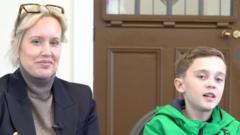
For 10-year-old Freddy, life can often feel unmanageable.
“He struggles with eating, food textures, smells, noise, crowds of people,” his mum Amy explained. “He gets very overwhelmed.”
Amy and Freddy have been taking part in a new six-week course in Lancashire designed to help parents whose children are autistic.
It is part of a major transformation in the way neurodivergence is being supported by the NHS and other organisations in the county.
Amy said Freddy began to show signs of autism when he was a toddler and unable to deal aspects of his surroundings.
When he went to school, others picked up on his condition.
“He would get frustrated very quickly, he would struggle in certain social situations,” she remembered.
“We would find him upset and he couldn’t tell us why.”
When Freddy was eight he received his formal diagnosis.
“To be told ‘Yes, he is autistic’ and Yes, he’s entitled to this support’ was a real eye opener for us,” said Amy, who felt she had been “guessing” the best way forward.
To get to that point, though, the family spent two years on a waiting list.
Waits of several years are common for autism and ADHD diagnoses, made worse by the huge rise in demand for them, particularly among younger people.
This scheme is just one of several being run by NHS Lancashire and South Cumbria, which is partway through a three-year transformation programme to completely change the way it helps people manage neurodivergence.
Assistant director for SEND and complexities Peter Chapman said families would still be able to access a diagnosis if they wanted to.
“It will absolutely be there – what we have seen is that if we put the support in at the earliest opportunity many people and families are self-choosing,” he said, adding that they were saying: “I don’t need the diagnosis because I’ve got the support that I want.”
The NHS is also working with local schools to bring in low-cost changes which can make life easier for pupils who struggle, ranging from changing how lessons are delivered to providing “a quiet place to have their lunch”.
Chapman added that a societal shift in how neurodivergence is viewed was equally important.
He said: “If we can bring through a generation of children now who understand neurodivergence in their peers it creates a culture in society that hopefully embraces what we’re putting out as the right way to support our families.”
It is a sentiment many carers here, like Liz, echo.
“It’s being more understanding and being more aware of these people and what they’re like,” she said.
“Not every disability can be seen.”