

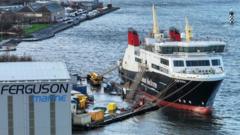
A direct award of new CalMac ferries contracts to the nationalised Ferguson shipyard is “not the right thing to do”, according to the boss of Scotland’s state-owned ferries procurement agency.
CMAL chief executive Kevin Hobbs told MSPs he was “100%” against giving the yard new work for two small ferries, despite a pledge by SNP ministers in March.
He said delays and overspends during its construction of two much larger CalMac ships were well known, and there was a risk the problems could be repeated.
Ferguson Marine said it had a proud shipbuilding record that stretched back far longer than recent controversies, while the GMB union said CMAL was itself responsible for many of the problems.
Transport Secretary Stephen Flynn, giving evidence at the same session of Holyrood’s transport committee, said the government remained committed to directly awarding the contracts to Ferguson Marine.
“I believe it is absolutely right that we put our confidence in Ferguson’s as the last commercial shipbuilder on the Clyde to be able to deliver these vessels for the island communities to ensure that we have resilience within the network, the resilience that they deserve,” he said.
CMAL has not awarded a shipbuilding contract to a Scottish or any UK shipyard since 2015, but has placed numerous orders with firms in Turkey, Poland and China.
The first phase of the Small Vessels Replacement Programme, involving seven small ferries, was awarded last year to Gdansk-based Remontowa, which undercut Ferguson’s on price even though the Scottish yard’s bid was praised by CMAL for its quality.
UK shipbuilders say overseas yards benefit from cheaper labour costs and better state support, and argue that the procurement model should take into account the wider benefits of placing orders with UK firms.
Plans to directly award the small ferries contract to Ferguson Marine were announced in March, a few weeks before the Holyrood election, by then transport secretary Fiona Hyslop.
At the same time former economy secretary Kate Forbes revealed plans to directly award the yard work on two other vessels – a marine protection ship and a research vessel, subject to the necessary due diligence.
Forbes said it would benefit island communities and the Inverclyde community as well as enabling the recovery of Ferguson’s, which is the last surviving commercial shipyard on the River Clyde.
Flynn told the transport committee the government remained committed to supporting Ferguson Marine through direct awards.
He said: “I am extremely confident in the yard and its ability to deliver and I think it’s fundamentally important that the Scottish government delivers a future for Ferguson’s and delivers for the islanders.”
Graeme Thomson, chief executive of Ferguson Marine, said the shipyard had a long history that stretched back much further than the recent difficulties.
He said: “Glen Sannox is now in service with Glen Rosa due to follow shortly and we have learned hard lessons from that programme.
“Today’s Ferguson Marine has new leadership, stronger governance, greater programme management control and a skilled workforce ready to deliver.”
He added that the firm was providing skilled jobs in Port Glasgow and keeping shipbuilding skills alive on the Clyde.
“Our recent past does not define our future and our focus remains on showing that our yard can and will build Scotland’s ferries well, on time and to budget,” he said.
While CMAL has been strongly critical of management at Ferguson’s in the past, it has often found itself accused of being partly responsible for what went wrong.
CMAL is believed to have been the driving force behind the choice of the liquefied natural gas (LNG) dual-fuel propulsion system, which added complexity to the construction of Glen Sannox and Glen Rosa.
Under questioning at the committee, Hobbs and CalMac boss Duncan Mackison both conceded that the two ferries might never run again on gas.
Glen Sannox has not used LNG since a faulty engine valve led to an unexpected leak in July 2025, and it is currently deployed to an area where refuelling with gas is not possible.
Hobbs said LNG was now hugely expensive and he believed there was “no way” a commercial operator would choose to run a dual-fuel ship on gas when it was so much cheaper to run it on diesel.
Mackison said there was “a question mark” over whether it was worth investing in new LNG facilities to refuel the ships.
The former owners of Ferguson’s have previously claimed the construction of the two ships ran into difficulties because CMAL launched the tender without doing sufficient preliminary work to establish that the specifications were feasible.
CMAL denied that, saying the problems arose mainly because of poor management decisions at the shipyard, and it refused to accept the yard’s claims for extra costs.
The stalemate eventually led to the firm going into administration in 2019, and it was later nationalised with design challenges, delays and cost rises continuing under public ownership.
Significant progress but also some of the biggest cost increases occurred from 2022 to 2024 while a CMAL employee was seconded to Ferguson’s to oversee the completion of the ships.
Uisdean Robertson, transport chairperson at Comhairle nan Eilean Siar, or Western Isles Council, said he did not oppose a direct award to Ferguson’s, but agreed with Hobbs that a new vessel was needed urgently.
Scottish Labour’s transport spokesman Paul Sweeney said Hobbs’ comments showed that “CMAL is now openly hostile to Scotland’s shipbuilding industry, a position that is completely untenable and unsustainable for a publicly-owned body”.